Powered By Blogger
Showing posts with label Orphan Train. Show all posts

Thursday, October 2, 2014

The Way Life Should Be by Christina Baker Kline

The Way Life Should Be by Christina Baker Kline
Published by William Morrow ISBN 978-0-06-236354-1
Trade paperback, $14.99, 272 pages

The first Christina Baker Kline novel I read, like most people, was Orphan Train. I found the story so engrossing, and I was surprised that I had never heard of the orphan trains before.

After that, I read Sweet Water by Ms. Kline and was happy to report that I enjoyed that one as well. I just finished another book from Kline's backlist, The Way Life Should Be, and I found this book the best of the three.

Angela is a 33 year-old single woman living in Manhattan, with a burgeoning career as an event planner for an art museum. She has a big event coming up that could bring her into the big time if it all comes together.

She has a loving father, a grumpy stepmother, and an Italian grandmother who loves Angela dearly. Nonna taught Angela all about Italian cooking, and Angela always enjoyed spending time in the kitchen with her.

The only thing missing in her life is true love. When her friend Lindsay meets a wonderful guy through online dating, Angela decides to give it a try. She finds a man who runs a sailing school in Maine, and they begin an online romance.

Angela has a picture in her mind of a quaint Maine cottage by the sea, her and her man living together in blissful love. When things go badly at work, she decides to pick up and move herself to Maine to give love a try with her online beau.

There are bumps along the way, but Angela sticks to her guns and is determined to stay in Maine. She starts hanging out a local coffeehouse, and the owner Flynn, an Aussie transplant who followed his heart (and a man too, like Angela), becomes her best friend and offers her a job.

She finds a tiny, dilapidated cottage (nothing like her dream) and convinces Flynn to redecorate the coffeehouse and offer homemade pastries and soups for lunch. Flynn persuades Angela to offer cooking classes, and she makes some new friends.

This book has so much that ticked all my boxes- Angela is a strong woman, Flynn is adorable, there are  lots of delicious descriptions of food (recipes included), a group of interesting new friends (with secrets) and a setting that is new to me (I must visit Acadia National Park).

As someone who has planned events, I found that part of the story fascinating. And any book that has food at its core, if it is well done like this is, will always appeal to me. I also liked that the characters are not one-dimensional (except the wicked stepmother). Angela's boyfriend Richard could have been the stock guy-who-is-really-a-jerk, but Kline gives him shades of color that made him more interesting.

The relationships- Angela and Nonna, Angela and Flynn, Angela and Lindsay- are so believable, you wish you were Angela. I will warn you that The Way Life Should Be will inspire you to dig out all of your food utensils and give Angela's recipes, like Pasta e Fagioli, Chicken Marsala and Basil Marinara, a try.

When Tom asks Angela who she really is, she thinks "the stories we tell about ourselves are filled with half-truths, distorted recollections, and blind spots as well as occasional moments of insight. It's all in the spin, isn't it?" And, I for one, liked the spin of Angela's story.

rating 5 of 5
My review of Orphan Train is here.
My review of Sweet Water is here.
My post about Christina Baker Kline's conversation with Caroline Leavitt at the Center For Fiction is here.
Thanks to TLC Tours for putting me on Christina Baker Kline's tour. The rest of her stops are here.
Tuesday, September 16th: A Lovely Bookshelf on the Wall
Thursday, September 18th: Sara’s Organized Chaos
Monday, September 22nd: BoundbyWords
Thursday, September 25th: Kritters Ramblings
Monday, September 29th: Kahakai Kitchen
Thursday, October 2nd: bookchickdi
Monday, October 6th: A Bookish Way of Life
Wednesday, October 8th: Carpe Libros


Thursday, August 7, 2014

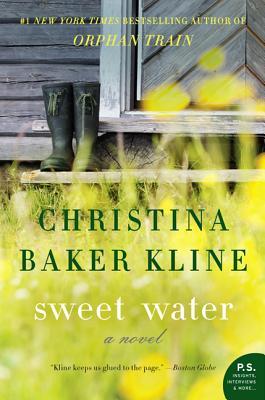
Sweet Water by Christina Baker Kline

Sweet Water by Christina Baker Kline
Published by William Morrow ISBN 978-0-06-236100-4
Trade paperback, $14.99, 290 pages

Christina Baker Kline's novel, Orphan Train, is still on the New York Times bestseller list over a year after its publication. It tells the story of a teenage girl, living with a foster family, who meets an elderly woman and finds that the woman was sent from New York City to the Midwest on an orphan train as a young child.

Kline's backlist is being rereleased, and I recently read Sweet Water. Like Orphan Train, it tells the story of two women who don't know each other- Cassie Simon, and her grandmother, called Clyde.

Cassie leaves her home in New York City after she receives information from a lawyer in Tennessee that her grandfather has died and left her his house and 60 acres of land.

Her life in New York is stressful. She works at a gallery and dates the gallery owner who has a wandering eye. She would like a chance to work on her sculptures, and this will give her the opportunity to start over.

Cassie's mother Ellen died in a car accident when Cassie was just three years old. Her grandfather was driving the van, and he was drunk at the time. Cassie's father took her away and she hasn't seen her mother's family since then.

Cassie alternates the narration with her grandmother Clyde. Clyde's part of the story goes back and forth in time, and we learn that she has a secret- a few of them, actually. We see Clyde as a young woman, a pastor's daughter who yearns to break free who meets a handsome piano player named Amory Clyde who sweeps her off her feet.

Clyde and Amory have three children- Horace, Ellen and Elaine. Amory spends much of his time working, and Clyde is left alone with the children. She is lonely and has few friends until she meets Bryce, an exciting, vibrant woman with a secret.

Horace and Elaine had hoped to inherit their father's land, and are mistrustful of Cassie. Why would she come back to Tennessee, to a place she doesn't know to family she never met, to live in a rundown house? Why doesn't she just sell it to them?

Cassie works on the house, and comes to like the town of Sweet Water. She works on her sculptures during the day and works at a bar at night. She even meets a guy, though he has a secret of his own.

The mystery of why Amory left his land to Cassie revolves around the death of Ellen and something that happened a few days prior to Ellen's death. Clyde seems to be hiding this all from Cassie, and Cassie is determined to find out what she is hiding.

Kline vividly creates the small town of Sweet Water, with its coffee shop, town park and resident busybodies. Anyone who has lived in small town will find it familiar.

The Clyde family dynamic is interesting too. The sibling and cousin relationships ring true, and the family dinner scene and the girls night out felt like the reader was right there in the middle of it all. (I'm a sucker for a good family dinner scene.)

Kline has some great lines in the book. Cassie is complaining to her father that her life in New York is ordinary, that she is just "filling a little space I've carved out for myself." Her father reminds her that that is what life is, no matter she may live.

When Cassie gives Clyde a ceramic bowl she made, Cassie gives Clyde several suggestions for things to put in it. Clyde asks why she has to put anything it it, and Cassie says "I don't know why, but I always think I have to fill things up." Clyde replies, "I used to feel that way. Now I guess I like things empty." I love that exchange, it tells you a lot about Cassie and Clyde.

In the end, I liked Clyde better than Cassie, and I felt much the same about the characters in Orphan Train. The older woman's story resonated more than the young teen. After reading this, I have come to the conclusion it is because the older women have more of a story to tell having lived a longer life.

Sweet Water will please fans of Orphan Train. It has a fascinating family story, interesting characters and lots of secrets to uncover.

rating 4 of 5
Christina Baker Kline's website is here.
My review of Orphan Train is here.
My blog post on Christina Baker Kline in conversation with Caroline Leavitt at the Center For Fiction is here.

Thanks to TLC Tours for putting me on Christina Baker Kline's tour. The rest of the stops are here.


Christina’s Tour Stops

Sweetwater

Monday, July 28th: Bound by Words
Tuesday, August 5th: Jorie Love a Story
Thursday, August 7th: bookchickdi
Friday, August 8th: Kahakai Kitchen
Monday, August 11th: A Bookish Way of Life
Tuesday, August 12th: Bibliotica

Tuesday, June 4, 2013

New in Paperback- The Chaperone by Laura Moriarty

The Chaperone by Laura Moriarty
Published by Riverhead Trade ISBN 9781594631436
Trade paperback, $16, 416 pages

What does it say about a book where silent film star/siren Louise Brooks, a real character who became famous (and infamous) for her outrageous behavior that she is not the most interesting character in Laura Moriarty's novel The Chaperone? That title belongs to Cora Kaufmann Carlisle, the title character of this beautiful novel.

Cora lived in an orphanage in New York City near the turn of the 20th century, unsure of her parentage. She was sent on the 'orphan train' westward to be chosen by a family where she would live. The orphans boarded the train, and at each designated stop, they would get out, sing a song, smile, and hope that they would be chosen by a family.

I had never heard of this 'orphan train' before, and the custom struck me as a perversion of the slave auctions held in the 19th century. Some of the orphans ended up with families who just wanted extra free labor, but Cora was lucky; the Kaufmanns chose Cora and grew to love her as if she was their own daughter.

So Cora ended up in Kansas, where she met Alan Carlisle, a lawyer. Alan courted her and they married. Cora had a difficult labor and gave birth to twin sons. Alan was a successful lawyer, and the Carlisles had a good life. Cora kept busy with volunteer work and her friends, yet she felt somewhat restless.

Cora heard that the Brooks family were looking for a chaperone to accompany their 15-year-old daughter Louise to New York City while she attended dance classes. Since her sons are off to college soon, Cora decides to take the job, hoping that she can find the woman who left her in the orphanage years ago.

Cora was taken aback by Louise's mother's complete disinterest in her own children. It seemed like she did not want to care for her children in any matter. Cora was hired for the job, which turned out to be much more than she bargained for.

Louise Brooks is larger than life, even at 15 years of age. She can't wait to be let loose in New York, and chafes at Cora's rules; it is a classic generation gap. The world is changing, and Louise is at the forefront of the change. She wears low-cut dresses, too much makeup and flirts shamelessly with any man who can get her something she wants.

Cora is frustrated by Louise's behavior, and more than a little frightened for her. She fears that someone will take advantage of Louise, and she is relieved when she finds that the dance teacher keeps a close tab on her students.

Living in New York, I found the part of the book set there utterly fascinating. Moriarty drops the reader into a hot summer in the city in the roaring 1920s, and you can smell, taste, see, feel and hear all of the city; it is a complete sensory experience.

The summer in New York changes both Louise and Cora's lives. Louise is chosen to stay on with the dance company and she eventually becomes a famous silent star. Cora returns home, but she is profoundly changed by the experience as well.

Secrets and the damage they do are a major theme in the book. Cora longs to find out who her mother is, her husband keeps a big secret from her (which I did not see coming!), and Cora keeps a secret from her children. Louise confides in Cora, and Cora has to decide what to do with the information.

Family is a theme too; what makes a family? Is it blood or can you create a family with people whom you love? Cora has to deal with that question for her entire life, and she seems to finally come to peace with it at the end of her life.

The title of the book, The Chaperone, is the perfect title, because we get the complete arc of Cora's life from beginning to end. As her story unfolds, we get to know a unique woman, a woman who finds her voice and her strength, who dares to make a life for herself.

I fell in love with this book, and you will too. The writing is mesmerizing, the characters intriguing, the setting fascinating. The sign of a good book for me is that I want to know more. Laura Moriarty has piqued my curiosity about orphan trains and Louise Brooks, and I was so pleased that she included some of her research sources in the acknowledgments.

rating 5 of 5

Laura Moriarty's webpage is here.
Christina Baker Kline has written a novel titled Orphan Train, which is on my TBR list. You can read more about it here.
I attended an event with Kline and author Caroline Leavitt (Is This Tomorrow) at the Center for Fiction, and my post about that is here.


Thursday, May 16, 2013

Christina Baker Kline & Caroline Leavitt at the Center for Fiction

Christine Kline & Caroline Leavitt

The Center for Fiction in NYC held a discussion between authors Christina Baker Kline (Orphan Train) and Caroline Leavitt (Is This Tomorrow) last month. I had never been there before, and I liked their set-up.

The event was held upstairs in a lovely, intimate space. The evening began with Kline talking about her new novel, about the orphan trains, which I had never heard of until I read Laura Moriarty's novel The Chaperone last year. (My review is here.)

Between the years 1854-1929, children from NYC were placed on trains that stopped in various places in the midwest. The children would get out on the train platforms, and people would choose children to come live with them. Many times, these farmers needed more help on their land, and these children ended up working as farmhands.

Over 200,000 children traveled on the orphan trains. Kline discovered a book about it on her husband's father's bookshelf on a visit to Minnesota and her she began a file on it. She did a lot of research on it,  and visited the Orphan Train Complex in Concordia, Kansas where they have over 300 first person narratives.

The children could bring nothing with them on the trains, no keepsakes; they were stripped of their identities. Their descendants are determined to keep there stories alive, and Kline's novel does that.

Orphan Train tells two stories- a troubled teen has to do community service and ends up helping an elderly women clean her attic. The woman was on the orphan train as a child and the women bond over   the older one's stories.

Leavitt says that she got the idea for her novel, Is This Tomorrow, from an unlikely source: TV's The Killing. She loved the show, particularly how the characters were not who the appeared to be. She combines the mystery in her story, a twelve-year-old boy goes missing in a Boston suburb in the 1950s, with some of her childhood story.

She was the only Jewish child in a Christian suburb, like her main character, and had very bad asthma. She spent much of her time alone. Leavitt was a smart child in a town where only 10% of the students graduated high school so her outsider status was cemented.

The 1950s setting interested her, she called it "one of the weirdest periods of all", citing its combination of need for "perfection with an undercurrent of fear of the Cold War." She did a lot of research, having three people assisting her, but she got some of the most interesting help from Facebook.

Leavitt has a big social media presence on Twitter and Facebook, and when she asked if anyone was a male nurse in the 1960s, or knew anything about crime in the 1950s,  she said "people told me bizarre stories." I guess the moral is be careful what you wish for.

Leavitt told the audience how her first seven books were well reviewed but didn't sell well. When she sent her editor Pictures of You, they passed, saying "it wasn't special." She asked all of her writer friends for names of other editors, and Algonquin Books told her they wanted it.

She has nothing but praise and gratitude for the people at Algonquin. She said she had five previous publishers and "no one wanted to meet me." At Algonquin, everyone was there at the office to greet her, and they helped get her books to a much wider audience.

They talked about the importance of social media and of helping other authors, Kline saying that "other people's success only helps us." It was a wonderful, informative evening and I got to meet Meg Wolitzer and tell her how much I loved The Interestings.

My review of Is This Tomorrow is here.