Powered By Blogger
Showing posts with label baseball. Show all posts

Tuesday, September 23, 2014

The Contract by Derek Jeter with Paul Mantell

The Contract by Derek Jeter with Paul Mantell
Published by  Simon & Schuster Books For Young Readers/Jeter Publishing ISBN 9781481423120
Hardcover, $16.99, 160 pages

Baseball fans across the country have been watching with interest and sadness as New York Yankees captain and baseball icon Derek Jeter is playing out his last year in baseball. Many people wonder what he will do next, and his answer is : become a publisher.

Jeter has his own publishing imprint with Simon & Schuster, where he will publish books by authors he finds have an something interesting to say. The first book under the Jeter Publishing imprint is for children ages 8-12 titled The Contract. Jeter wrote it with Paul Mantell, and it is based on his own life as a Little Leaguer.

Young Derek Jeter, called 'old man' by his mom because he went to school in a suit and carrying a briefcase, is a talented baseball player and a serious student. When his classroom teacher assigns the students an essay describing their realistic future dreams, Derek really wants to write that his future plans include playing shortstop for the New York Yankees.

He discusses this with his parents, who encourage him to realize how difficult it will be, but with his excellent work ethic and determination and practice, he can do just that.

Derek signs up for Little League and ends up playing on a team with his best friend Vijay. He wants to play shortstop, but the coach's son is the star shortstop with a bad attitude.

Much of the book describes in detail many of the Little League games, and children who love baseball will so enjoy the thrilling play-by-play. But this book is also one parents should read to or with their children.

Derek would not be the great player he is today were it not for his parents. They created a contract for Derek, detailing what he needs to do to set himself on a path to achieving his dream. The items include respecting himself and others, doing his chores, being a good role model for his younger sister, maintaining good grades and the number one rule is family comes first.

The Contract not only teaches children how to be responsible, it can help parents with their own parenting skills. The Jeters are good role models for their two children, and hold them both to high standards, knowing that it is the key to raising good citizens.

I liked how important school is to Derek, how he works as hard at school as he does at baseball. And Derek is not a perfect child here; he gets frustrated and angry, but when he makes a mistake, he tries to be better.

The final scene is a sweet one, with Derek playing catch with his grandma, with whom he and his sister spend their summers. They clearly have a loving relationship, as many young children do.

I highly recommend The Contract for both children who like baseball, as well as their parents. It would make a wonderful gift for the young baseball fan in your life, and it would be a terrific addition to your child's school library.

5 of 5 stars

Friday, August 8, 2014

Red Sox Vs. Yankees: The Great Rivalry by Harvey Frommer and Frederic J. Frommer

Red Sox Vs. Yankees: A Great Rivalry by Harvey and Frederic J. Frommer
Published by Taylor Trade Publishing ISBN 978-1-58979-918-9
Trade paperback, $18.95, 274 pages

Growing up in a baseball family, my dad and sister were Boston Red Sox fans and my mom and brother liked the Yankees. The heated rivalry that has been decades long in the making played itself out in our home growing up.

Red Sox Vs. Yankees: The Great Rivarly by Harvey Frommer and Frederic J. Frommer does justice to perhaps the most famous rivalry in all of sports history. Frommer wrote for Yankees Magazine for over twenty years, but now lives in New England, so he gives both sides their fair say.

The book is a comprehensive overview of how the competition started, and goes in-depth in covering some of the greatest moments in the history of the rivalry. The authors begin with the end of the infamous "Curse of the Bambino", when the Red Sox finally beat the Yankees when it counted- the 2004 American League Championship, where the Sox came back from a 3-0 game deficit to win four in a row and go to the World Series.

It almost didn't matter if they won the World Series (which they went on to do); they beat the damn Yankees and finally vindicated the day the Red Sox gave Babe Ruth to the Yankees who went on to help the Yankees create their dominant baseball dynasty.

The Frommers give an extensive timeline of events in the rivalry, but it is the chapters on the 2003 playoffs (when Sox pitcher Pedro Martinez threw 70-year-old Yankee coach Don Zimmer to the ground during a bench-clearing team brawl), the 1978 teams (with amazing players like Jim Rice, Carl Yazstremski, Luis Tiant, and Fred Lynn for Boston against Reggie Jackson, Mickey Rivers, Ron Guidry and Catfish Hunter leading the powerful Yankees), and the 1973 teams (where a home plate collision between catchers Thurman Munson and Carlton Fisk ignited a memorable fight) that are the strongest.

Those chapters bring memories rushing back for those of us who watched the games, and the Frommers put us in the middle of the action with all the players weighing in.

The end of the book features memories from players and fans, like Rudy Guiliani, Mario Cuomo, Roger Clemens, and Ari Fleischer, which I found interesting.

Red Sox Vs. Yankees is a must-have sports book, not only for fans of those teams, but for all baseball fans.

rating 4 of 5

Saturday, March 15, 2014

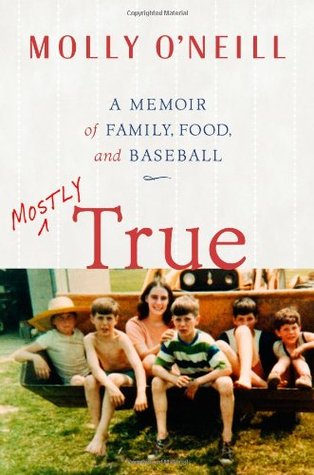
Weekend Cooking- Mostly True by Molly O'Neill

This post is part of Beth Fish Reads' Weekend Cooking.  If you have anything related to food, cookbook reviews, novel or non-fiction book reviews, recipes, movie reviews, etc., head over to Beth Fish Reads and add your post. Or, if you want to read food related posts, head over to read what some interesting people have to say about food.
Mostly True by Molly O'Neill
Published by Scribner ISBN 978-0-7432-3269-2
Paperback, $20.95, 288 pages


A few weeks ago I posted a review of Julia Pandl's Memoirs of the Sunday Brunch, and Sarah, a Goodreads friend, suggested I might like Molly O'Neill's Mostly True- A Memoir of Family, Food and Baseball. Since those are three of my favorite things, I searched and found the book and read it.

Sarah was right; what a fantastic memoir! Molly is the oldest O'Neill child, followed in succession by five boys in the 1950s and 1960s. They grew up in Columbus, Ohio, a close-knit crew, and much of their lives revolved around baseball (like mine growing up). Her dad loved baseball and encouraged his sons to play the game; youngest son Paul grew up to play for the legendary New York Yankees (and before that, the Cincinnati Reds, a team close enough to home for his parents to watch him play often).

Anyone from a big family will relate to Molly's memories of growing up in a big family. Molly's attitude towards food came from her parents, who had a different idea than many people at that time. Columbus was (and still is) the test-market capital for food products. Grocery stores were filled with product samplers, while ubiquitous today, were not found in may places in the Unites States  back then.

The O'Neill's, however, did not serve their children pot pies or macaroni and cheese or tuna noodle casserole or even meat loaf. Her parents "practiced a separation of food groups. We had meat. We had potato. We had vegetable. We had salad. We had dessert.. Each was distinct and none was overcooked. It was humiliating."

Molly first became interested in cooking when she was trying to lose weight. She joined a weight loss support group because her brother mercilessly teased her about having unidentifiable kneecaps. There, a woman gave her a cookbook and Molly started cooking for herself because her mother would not make a separate meal for her. Soon Molly ditched the low calorie cooking and moved on to making recipes out of Julia Child for her grateful family.

She went to college in Massachusetts, became a feminist, wrote poetry and helped to start a feminist, humanist, vegetarian restaurant. As the women who ran the restaurant began to become more and more militant about what could be served, Molly became more creative with ways to make broth without any trace of beef and ways to use tofu.

After college, she settled in Provincetown, working at many restaurants. I loved reading about how Molly got her hands-on education, how she fought for her place in the male-dominated kitchens. Surely growing up with male siblings helped her here.

Molly gained a reputation, and a following, and soon two of her brothers followed her into the business. She got them jobs and they all cooked together.

Eventually Molly went to Paris to learn how to make desserts, she became friends with her neighbor Julia Child, she moved to New York and ended up a New York Times restaurant critic and a famous cookbook author.

Paul was playing for the Yankees while Molly was living in New York, so she spent many games sitting in the stands watching him and her father, who was so thrilled to have a son playing Major League baseball. Molly's mom was thrilled to be able to shop in New York.

This is a book for anyone who is fascinated by food, family and yes, baseball. But it is much more. It is the story of a woman finding her way through her passion and I absolutely loved it. I know I will read this one again and again. Thanks to Sarah for the suggestion!

rating 5 of 5

You can find some of Molly recipes on Cookstr here. 
My review of Julia Pandl's Memoir of the Sunday Brunch is here.

Tuesday, April 2, 2013

New in Paperback- Starting and Closing by John Smoltz

Starting And Closing: Perseverance, Faith & One More Year by John Smoltz with Don Yaeger
Published by William Morrow Paperbacks ISBN 97800662120564
Trade paperback, $14.99, 304 pages

Baseball season opened yesterday and if you want to read a terrific book about baseball, Starting and Closing is it.

John Smoltz is one of the best pitchers to ever play major league baseball. For over twenty years he pitched for the Atlanta Braves, chosen eight times for the All-Star team and winning the Cy Young Award for best pitcher in 1996.

He pitched in the starting rotation for fourteen years when an injury caused him to move to the bullpen and become a relief pitcher. After three years in the bullpen, he asked to rejoin the starting rotation. Many people, particularly in the sports media, asked him why he did this. His response: Why not?

Smoltz begins the book with three things people need to know about him:
1. All he ever wanted to do was win
2. He's not afraid to fail
3. He never did anything in his baseball career just to set a record, or to be able to say that no one else has done what he has done

Smoltz lived in Michigan, and his grandfather worked at the Detroit Tigers stadium. Young John grew up going to Tigers games, and he loved the Tigers. He was thrilled to be drafted by his hometown Tigers to play baseball, and disappointed when they soon traded him to the Atlanta Braves.

His disappointed turned to happiness when he realized that the Braves were willing to work with him, that they valued their young players and worked hard to make him a successful pitcher. (The Braves are  known for their excellent farm system.)

Injuries plagued Smoltz throughout his career, and he pushed his body through the pain, hoping to avoid Tommy John surgery, which could end his baseball career. He eventually had the surgery, but with his amazing work ethic, he began a grueling rehab program and came back to pitch again, although as a closer.

As a person who worked best with a steady routine, Smoltz found it difficult to get used to the unpredictability of being a reliever. As a starter, he knew which day he would pitch, so his mind was set. He could play his favorite hobby, golf, on his off-days. He said that "by going to the bullpen, I sacrificed two things that really helped me tick: knowing what was coming and feeling like I was in control."

Besides baseball, two other things motivated Smoltz: golf and being a born-again Christian. He described the moment he knew that his relationship with God had to change, and how his life changed for the better because of it. He soon became a popular speaker at 'baseball church' gatherings, and later founded a Christian school in an Atlanta suburb.

Now that he is retired, Smoltz has set his sights on joining the Champions Tour in golf , and Tiger Woods has said that publicly that Smoltz is the best amateur golfer he has seen. Smoltz frequently played golf with his pitching teammates, Tom Glavine and Greg Maddux, and you can feel the joy on the pages where describes their bonding over golf.

Smoltz was not re-signed by the Braves after twenty years, and he joined the Boston Red Sox for a final season. He describes the sadness he felt at leaving the team he helped to bring to 14 post-season playoffs, although with only one World Series title. I found his analysis of the toll that pitching in so many consecutive post-seasons took interesting, and I have to say it never occurred to me how damaging it could be.

Boston was a disaster, and Smoltz was happy to be picked by up the St. Louis Cardinals after the Red Sox released him halfway through the season. He was happy to be able to contribute to the Cardinals playoff run, but wistfully says that he wished he could have ended his career in Atlanta.

Starting & Closing is not your typical sports memoir; Smoltz really concentrates on his last season, sprinkling little parts of his life throughout. You get a real feel for what makes this intriguing man tick, why he was so successful in baseball although plagued with injuries, and how his changed relationship with God made him a better man and a better pitcher.


rating 4 of 5


Tuesday, March 13, 2012

The Emerald Diamond by Charlie Rosen

The Emerald Diamond by Charley Rosen
Published by Harper Collins ISBN 978-0062089885
Hardcover $25.99

Saturday is St. Patrick's Day, and since spring training is well underway, it's a good time to review Charley Rosen's book The Emerald Diamond: How The Irish Transformed America's Greatest Pastime.


I'm proudly Irish and have been a big baseball fan since childhood, so this book held great appeal for me. I had never really considered the Irish contribution to baseball, and Rosen's book is comprehensive in his thesis.

As the Irish wave of immigration exploded during the potato famine in the 1840s, the author states that
"only four paths of advancement were readily available to young Irish males: politics, police work, the priesthood and sports." 
Many sports were out of reach for immigrants- golf, tennis, football, track and field were the purview of the wealthy and college educated. Boxing and baseball appealed to the Irish immigrants. Baseball was their game
"because the basics of the sport involved manipulating a bat (which strongly resembled the ancient Irish war club known as the shillelagh), running fast, and throwing a ball hard and accurately- all skills familiar to traditional sporting pastimes in Ireland. "
Rosen's intertwined history of baseball in America and the Irish immigrants who played the game utterly fascinated me. In the late 1880s, Irish players became valued for their contributions to the game. The Sporting News wrote that the Irish were "distinguished by their ability to quickly devise plans and schemes." The American Press Association said it was due to their "love of a scrap and proficiency in the use of a club."

The schemes that some of the Irish players devised are recounted with great humor and admiration here. Mike "King" Kelly frequently took advantage of the fact that when there was only one umpire who had to watch the play at first, he would take a "shortcut" while rounding third to get home, eliminating 20 feet or so.

Kelly also would hide an extra ball in his uniform shirt and if it was dark out and a fly ball went over the fence, he would pull the ball from shirt and claim to have caught it for an out. There are many clever and funny tales like this that had me giggling, because I know a few coaches who would love to pull some stunts like that.

Some of the greatest managers in the game were Irish; Joe McCarthy, John McGraw, Casey Stengel and Connie Mack brought many innovations to the game that still exist today. When Mack was a catcher, he one was one of the first who would attempt to throw out the trailing runner in a double steal. He was also the first catcher who would physically block the plate when the runner attempted to score.

I'm from Auburn, NY and one of the interesting tidbits in the book concerns McGraw who, at the end of every season, donated the Giants used uniforms to the Auburn Prison baseball team. I had never heard that bit of lore.

Each chapter begins with a quote, and my favorite is from George Bernard Shaw- "People who say it cannot be done should not interrupt those who are doing it." I think I'll put that one on my family's coat of arms.

The book profiles Irish players, coaches, and even umpires, from every era and gives their stats. I grew up loving baseball and being proud of being Irish, yet I never thought about the important contributions the Irish made to the great game of baseball.

This is a wonderful book to give to the Irish sports fan in your life; it makes the perfect St. Patrick's Day or Easter gift, just in time for opening day in April.

rating 4 of 5 stars

Thursday, December 15, 2011

The Last Icon: Tom Seaver and His Times

The Last Icon: Tom Seaver and His Times by Steven Travers
Published by Taylor Trade Publishing ISBN 978-1-58979-660-7 
Hardcover, $24.95
Tom Seaver is the quintessential New York Met. The Mets were a hapless team, a joke in baseball when Seaver was signed in 1966. Steven Travers' new book, The Last Icon: Tom Seaver and His Times takes you back to those days.

Seaver was a Southern California boy, raised in a conservative family in a conservative community. He was not the best baseball player, but he loved the game. He became a real student of the game, studying the history of it and mechanics of pitching.

He was one of the first major league players to use a weight training program, after discovering that working in a loading dock at a factory made him stronger and improved his stamina and pitching.

I learned many things from this interesting book. I had heard of the Cape Cod league for up and coming players, but I had no idea that what Cape Cod was to east coast baseball, Alaska was the western equivalent. Who would have thought that? Seaver's days playing for a great coach in Alaska help make him the great player he became.

The Vietnam War was raging, and I never knew how many players were in the reserves, and missed games to serve their weekends. I can't imagine that happening today.

Seaver was an intelligent guy, and during the off-season, he went back to USC to take classes to finish his degree. Not many athletes then or now would do that, although back in the 1960s, the contracts were not that lucrative.

Winning was important to Seaver, and he had a strong work ethic. It annoyed him that many of the players on the Mets did not take the job of baseball seriously. Some of his teammates did not like Seaver, thinking that he believed himself to be better than they were. He had a reputation for being faithful to his wife on the road, and this bugged some players, while others tried to live up to Seaver's high standards.

Growing up in a conservative white community, thoughts on race were different then, something from which the author doesn't shy away. Jackie Robinson had opened the door to black major leaguers, and men like Seaver found their views on race challenged.

The season of 1969, when things really jelled for the Mets, is detailed here. Seaver led this team, which had great pitching but lacked hitting. He consistently posted annual ERAs of under 2.00, yet he lost many games 1-0, 2-1, 3-2 because his team did not score enough runs. They seemed to save their runs for pitchers like Jerry Koosman.

Seaver dominated the game, winning the Cy Young Award three times, yet he never won the league MVP, though many people thought he deserved it. He won more games than any other Mets pitcher, led the league numerous times in strikeouts, wins and ERA.

The author did not get to interview Seaver for this book. He culls many other books and magazine articles, including many that Seaver himself has written, though Seaver has not written the definitive autobiography he has said he would one day write. (Reportedly his management has said that not enough money has been offered.)

The Last Icon is a must-read for any Mets fan, and for any baseball fan for that matter. Travers not only gives you a look at this fascinating man, but he evokes a time in baseball when baseball was the American past time. I was taken back to a magical time in my life, when I couldn't wait to watch the Saturday afternoon game on TV with my father and siblings.  If you have a baseball fan on your Christmas list, this is a fantastic gift.

rating 4 of 5

Friday, April 1, 2011

Bottom of the 33rd

Bottom of the 33rd- Hope, Redemption, and Baseball's Longest Game by Dan Barry
Published by Harper Collins- ISBN 978-0-06-201448-1
Hardcover, $26.99

Major League Baseball just opened up another season, so the perfect book to read this week is Dan Barry's Bottom of the 33rd- Hope, Redemption, and Baseball's Longest Game.


The game took place on April 18, 1981, Holy Saturday, in Pawtucket, Rhode Island. The Triple A League Pawtucket Red Sox hosted the Rochester Red Wings. The Sox had future superstar Wade Boggs on their team, the Red Wings had the incomparable Cal Ripken Jr. at third base.

But Barry wisely does not put those superstars at the center of his story. What makes this narrative interesting are the not-so-famous people. The Pawtucket owner, Ben Mondor, a wealthy businessman who grew up poor in Pawtucket and made it big, took the team at its lowest point and restored it to its former glory.

He prized loyalty above all, and when Budweiser refused to sell him beer because the former owners owed them money, he remembered that for a long time. Miller sold him beer, and even though Budweiser was the fan favorite, and Budweiser eventually begged him to buy their beer year after year, Mondor stuck with Miller because they were loyal to him.

Mondor put together a small but hardworking front office team, and they turned the bankrupt team into a success by "keeping prices low, making the stadium safe and family-friendly and emphasizing that the Pawtucket players on the field were the Boston Red Sox of tomorrow."

One of the most unforgettable characters is pitcher Win Remmerswaal. He is from the Netherlands, and "doesn't seem to accept basic social customs, such as adherence to the law or value of currency." His car license plate was a "piece of cardboard with a few meaningless numbers scribbled on it." At the end of one road trip, it was discovered that he was missing. He showed up several days later, explaining that he had never seen the nation's capital, so when they had a layover in Washington, he took a few days to sightsee. He is hilarious!

Triple A baseball is the last step before the major league team, so there is an interesting dynamic on those teams. There are the young players destined for future glory, like Boggs and Ripken. There are 'old guys'- the 25 and 26 year-olds- who have kicked around for awhile, and this is their last shot at making the big team. Some of them get called up to play in September on the parent club, only to be sent back to Triple A next spring to try again.

The agony of working to see your dream come true, knowing that there is a short time limit on it, is palpable in this book. First baseman Dave Koza has dragged his wife Ann from Florida to Pawtucket to Wyoming every year in pursuit of his dream. Ann finds some kind of factory work wherever they land, and she goes to every game. She is one of the 19 people who watched all 32 innings of the game, lasting until 4am on Easter morning when it was finally called. They are the heart of this marvelous book, and the end to their story is so moving.

The longest game, which is finally finished two months later in Pawtucket, is told in detail, alternating with the stories of the people who participated in it. I grew up in Auburn, NY, which has a Single A baseball team, and this book really resonated with me. I know my entire family will want to read it.

Barry gives the reader a close-up look at our national pasttime, and what that means for the cities where it is played. He tells the stories of the participants with honesty, humor, and heart. If you liked the movie, Bull Durham, this book is for you. It is a must-read for every baseball fan.

rating 5 of 5 stars


Friday, July 16, 2010

Friday Five- Volume 7

In honor of this week's Major League Baseball All-Star game- congrats to the National League for its first win since 1996, and to Atlanta Braves' Brian McCann for being named the MVP- this week's Friday Five is:


Five Fabulous Major League Baseball Ballparks:

1. PNC Park in Pittsburgh- We have family in Pittsburgh and have been to the stadium a few times. It is a beautiful stadium, and anywhere you sit you get a great view of the game and a fantastic view of the Pittsburgh area with their three rivers. Now the Pirates just need to win.

2. Fenway Park in Boston- Fenway is an old-school stadium, reveling in the glory of baseball when it was still the national past time. And there is nothing like seeing the Green Monster up close. It must be very romantic too, because every time we've been there, some guy has proposed to his girl.

3. Turner Field in Atlanta- Although it is ungodly hot to watch a baseball game in Atlanta in August (let alone three), I love Turner Field. I like that they have an area where families can bring in their own food and have a picnic before the game. They have lots of activities too and the best pretzels around- dipped in butter. (It was the only food I ate for three days, so I didn't feel too bad.)

4. Citi Field in New York- The Mets new ballpark is amazing, as befits the Amazings. The Jackie Robinson Rotunda is stunning- as you take the escalator up into the stadium, you can't help but be impressed. They also have Blue Smoke BBQ and Shake Shack burgers. There's always a line for Shake Shack, but for some reason, you can walk right up to Blue Smoke and get the best BBQ in NYC.

5. Yankee Stadium- The Yankees got a new stadium, and boy did they need it. Great Hall has huge banners of Yankee greats hanging to greet you as you enter the stadium, and the Monument Park is still there. I do like that the food stands have a credit card machine where you place you order and can skip the lines to get your food- very efficient. My husband likes to sit near Carl's Cheesesteaks. I like the Cuban sandwiches at Moes.