Powered By Blogger
Showing posts with label non-fiction. Show all posts

Thursday, March 21, 2019

How to Know the Birds by Ted Floyd

How to Know the Birds by Ted Floyd
Published by National Geographic ISBN 9781426220036
Hardcover, $28, 295 pages

Although the beautiful cover of Birding magazine editor Ted Floyd's How to Know the Birds may lead you to believe that this will be your typical book about birds, you would be wrong.

Many bird books are field guides, with page after page of color photos or drawings of birds, along with short descriptions of what the bird look like and where you find them. Floyd's book is different. He begins by describing the history of birding, referencing the seminal books in the field. It was a quiet, gentle, often solitary study by people with sketchpads, pencils, binoculars and notebooks.

Then he takes us into the present, where birding has evolved like most things- people use their smartphones to take photos to upload to numerous Facebook pages devoted to birding. There are apps to help birders organize and connect with other birders. It is much more immediate and social.

Floyd introduces us to 200 bird species, each one getting a page but not necessarily a drawing. (There are a small number of beautiful pencil drawings by N. John Schmitt that accompany some of the text.)

The contents are divided into six sections, organized by the calendar year, beginning with Spark Bird, which covers January-February. He discusses the birds you will likely find during those months in North America, gives the common name for the bird, such as American Robin, then its scientific name Turdus migratorius, which always capitalizes the first letter of the first name and the second name always begins with a smaller case letter.

He gives you a short description of the bird, and interesting fact about the bird that is the title of the page. For the essay titled He Says, She Says, we learn about the Great Horned Owl and the difference between the sounds the male and female makes. In The Upside of Human-Modified Landscapes, he talks about the Canada Goose and how these geese have evolved to "flourish in human-dominated landscapes" living near high-rise office buildings, on golf courses and wreaking havoc near airports.

Floyd sprinkles in pop culture references, talking about the movie On Golden Pond in the essay about the Common Loon, or comparing a Star Trek TV series scene to a large nest which holds a tiny Bushtit. He of course mentions the Jack Black/Steve Martin movie The Big Year, perhaps the only movie about birding ever made.

The book ends with a helpful checklist of all the birds described by species.

How to Know the Birds is really written for the person who enjoys birding as a serious hobby more than for a person looking to get into birding. It would make a wonderful gift for your favorite birder, maybe in an Easter basket.


Thanks to TLC Tours for putting me on Ted Floyd's tour. The rest of his stops are here:

Tour Stops

Tuesday, March 12th: Just a Secular Homeschooler
Wednesday, March 13th: Man of La Book
Monday, March 18th: Mockingbird Hill Cottage
Tuesday, March 19th: Doing Dewey
Wednesday, March 20th: Broken Teepee
Thursday, March 21st: bookchickdi
Monday, March 25th: The Birders Library
Tuesday, March 26th: Instagram: @dropandgivemenerdy
Wednesday, March 27th: Instagram: @bookishinmpls
Thursday, March 28th: View from the Birdhouse
Friday, March 29th: Based on a True Story
Monday, April 1st: Pure Florida
Date TBD: 10000 Birds
Date TBD: The Birdist
Date TBD: Jathan & Heather


Friday, March 16, 2018

In Praise of Difficult Women by Karen Karbo

In Praise of Difficult Women by Karen Karbo
Published by National Geographic ISBN 9781426217746
Hardcover,  $26, 346 pages

In the introduction to Karen Karbo's In Praise of Difficult Women: Life Lessons from 29 Heroines Who Dared to Break the Rules, the author states that "a difficult woman is a woman who insists on inhabiting the full range of her humanity." This book profiles 29 women in modern history who do just that.

Each chapter profiles one woman, beginning with a single word to describe them ("Fiesty" for Harry Potter author J.K. Rowling, "Indefatigable" for Justice Ruth Bader Ginsburg, "Determined" for Jane Goodall) and a vibrant illustration by Kimberly Glyder.

 Karbo writes a short sketch of each remarkable woman, and her opinion of what it is that makes each of them "difficult". I am familiar with all of the names in the book, but I got an deeper understanding of women whom I didn't know much about, like "imperious" French fashion designer Coco Chanel, who gets a longer chapter (perhaps because Karbo's previous book was The Gospel According to Coco Chanel).

People responded to her book about Chanel by saying it seemed that Chanel didn't seem like she was a nice person. Karbo would often say that Chanel was a "complicated, stubborn, ambitious visionary who transformed the way we dress, view ourselves in clothes and walk through the world. You need her to be nice on top of everything else?" People don't usually comment on ambitious men's "niceness".

"Fanatical" Eva Peron gets a longer chapter too, and for those who only know her from the Broadway musical "Evita" will appreciate maybe the most complicated woman in this book. Peron came from extreme poverty (as did Josephine Baker), and as the mistress, then wife, of Argentinian President Juan Peron,  she spent much of her time giving food, money and more to the poor in her country. She and her husband also refused to listen to any dissent, punishing those who disagreed with them, shutting down newspapers, unions, and impeaching Supreme Court justices.

I also found chapters on Josephine Baker, Frida Kahlo, Amelia Earhart, and Janis Joplin fascinating. Angela Merkel's story- a research scientist who lived under Communism in East Germany to rise up and become a unified Germany's Chancellor and now the leader of the free world- gives smart girls everywhere hope.

Many of us know Kay Thompson from the Eloise children's books, but her contributions to musical comedy world are innumerable. She was a choreographer, lyricist, vocal coach (Frank Sinatra owes her much), and it was her idea to have singers sing and dance at the same time on stage, instead of just standing at a microphone singing. The word diva was made for Thompson.

Perhaps the most moving anecdote that Karbo shares is a personal one. She was in First Lady Hillary Clinton's West Wing office in 2000, and she was speaking with an engaging young aide.  When Karbo asked her what was the best part of working for the First Lady was, the young lady's face "opened into a grin." She makes me feel smart!"  That doesn't make Clinton difficult, but it speaks volumes as to who she is.

In Praise of Difficult Women is a great read for Women's History Month. You can dip into it and read a few chapters while riding the bus, waiting at the doctor's office or in your car at school pickup. You're sure to find more than one who will inspire you to be a difficult woman. And if you want further reading about these remarkable women, Karbo shares her sources at the end, with further reading on her website here.


Thanks to TLC Book Tours for putting me on Karen Karbo's tour. The rest of her stops are here:

Tour Stops

Tuesday, February 27th: A Bookish Way of Life
Thursday, March 1st: A Bookish Affair
Monday, March 5th: Broken Teepee
Tuesday, March 6th: Ms. Nose in a Book
Wednesday, March 7th: Literary Quicksand
Tuesday, March 13th: Tina Says…
Wednesday, March 14th: Doing Dewey
Thursday, March 15th: Bibliotica
Friday, March 16th: bookchickdi
Monday, March 19th: Openly Bookish
Monday, March 19th: Cerebral Girl in a Redneck World


Wednesday, June 28, 2017

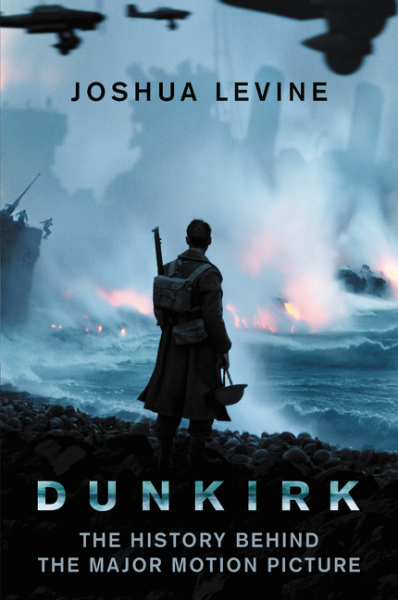
Dunkirk- The History Behind The Major Motion Picture by Joshua Levine

Dunkirk by Joshua Levine
Published by William Morrow ISBN 9780062740304
Trade paperback, $16.99, 339 pages

Christopher Nolan, the creative genius behind The Dark Knight (Batman), Inception and Memento turns his eye next to Dunkirk, which tells the true story of a major British military evacuation off the coast of Belgium during WWII.

Dunkirk is based on a book of the same name by historian Joshua Levine. Levine's 2011 book has been updated for the upcoming movie release, and it is bookended with an interview between Levine and Nolan at the beginning of the book about why Nolan chose this project, and a chapter at the end of the book discussing the process of making the movie, including comments from members of the production team. Movie buffs will love these extra chapters, giving them a fascinating insight into the process of moviemaking.

History buffs will love the actual story of Operation Dynamo itself. I confess to not being a big military history reader, so the sections of the book I found most intriguing had to do with the historical perspective of the events that led up to Britain's involvement in WWII.

Great Britain was still reeling from the effects of WWI, fought nearly twenty years prior. They lost an entire generation of men in WWI, and the thought of losing another generation to a war with Germany was not one that many people wanted to contemplate.

The worldwide depression severely impacted Great Britain, with unemployment high. With no system of welfare, there was tension between the classes, and extreme political parties were able to gain a foothold exploiting this. One can see echoes of this in today's world events as well.

Prime Minister Neville Chamberlain believed that he could work with Hitler's Nazi government to avoid war. He was accused of appeasement, and this led to the election of Winston Churchill as Prime Minister of Great Britain during the most trying time in history.

Churchill approved the plans for Operation Dynamo, which called for the evacuation of as many as 40,000 British troops from Dunkirk. The Germans were about to surround the British and French troops, and in order to save the troops from a certain slaughter or capture, they must arrange for an evacuation. Failure to save these troops would mean that the Allies would most likely lose the war, and the world today would be a much different place if that had happened.

The book goes into great detail about the actual logistics of the evacuation, a monumental task. Every available military and private ship and boat was recruited to make the trip to Dunkirk to ferry the soldiers back to England. There are many remembrances from people who make that voyage, and they are so interesting.

The troops were sent to the beach, and with tens of thousands of soldiers along the beach, some for many days, it became a little city of its own. Men played cards, built small shelters, and waited and waited until it was their turn to wade out in to the sea to be rescued, all while being attacked from the sky by German airplanes.

Levine compared this scene to the one of refugees from war and poverty who are taking any form of floating apparatus to get to the shores of Greece and Italy, an apt comparison.

Dunkirk is a fascinating look at a historical event that many people don't know about. While some people felt that this event was a story of a failed battle, Levine looks at it as an incredible story of survival. The goal was to save 40,000 troops, and the reality was that over 260,000 troops were rescued from the shores of Dunkirk, an astonishing number.

England used Dunkirk as a rallying cry and people in England today still speak of the "Dunkirk Spirit" when talking about bucking up and working together to achieve a goal that seems unattainable.

I highly recommend Dunkirk for movie fans, history and military history buffs.

Joshua Levine's website is here.
The website for the movie Dunkirk is here.


Thanks to TLC Tours for putting me on Joshua Levine's tour. The rest of his stops are here:


Tour Stops

Tuesday, June 27th: Savvy Verse & Wit
Wednesday, June 28th: bookchickdi
Thursday, June 29th: Dwell in Possibility
Friday, June 30th: Mama Vicky Says
Monday, July 3rd: Ace and Hoser Blook
Wednesday, July 5th: My Military Savings
Thursday, July 6th: Books & Tea
Monday, July 10th: Man of La Book
Tuesday, July 11th: A Bookish Way of Life
Wednesday, July 12th: Jathan & Heather
Thursday, July 13th: Tina Says…


Thursday, March 30, 2017

Epic Measures by Jeremy N. Smith

Epic Measures by Jeremy N. Smith
Published by Harper Wave ISBN 978-006-223751-4
Trade paperback, $15.99


Given that Congress is in the process of deciding which health care bill will best serve Americans, Jeremy N. Smith's book Epic Measures One Doctor. Seven Billion Patients. is a most timely read.

Although we live in the "Age of Big Data" as Smith states, where we all have Fitbits to track our every step, and you can pay $99 to have your DNA analyzed, it is remarkable that we don't have accurate statistics on what makes people ill and what they die from. In 147 of 192 countries, reliable death certificates do not exist.

 Chad Murray, an Oxford graduate, came to believe that his life's mission was to "measure how we sicken and die in order to improve how we live". Murray is a physician and economist, and an extremely driven man. His interest in health care began when his family went to work at a hospital in Niger (he was ten years old).

The hospital had no electricity, water or supplies, but they had plenty of patients.  Chad was the pharmacist, errand boy and assisted his father by holding the light so he could perform surgery. He learned how to persevere under difficult conditions.

Because Murray "combined the talents of a demographer and an epidemiologist, a biologist and a doctor, an economist and a policy expert", he was uniquely qualified to see the big picture of disease and mortality.

Murray's prickly personality hurt him when it came to working with others in the political arena. Worldwide organizations like the World Health Organization (WHO), UNICEF, and the UN led the way in working on health care issues, especially in the arena of childhood mortality.

Many people felt threatened by Murray's assertions that we must get accurate statistics on disease and disability in adults in order to objectively measure the health of the entire world. After working with many established organizations, Murray founded The Institute for Health Matrics and Evaluation, with the help of Bill Gates.

Murray and his staff of many around the world created a matrix that wanted to "turn information into evidence, evidence into action and action into results." They believed that global health is an instrument for social justice.

Epic Measures is not just a book that will interest statistic or math geeks, health care providers and politicians, it is a fascinating look at how the most basic human need- good health- can be achieved through getting accurate information, and once you had that, realistically finding solutions.

Fans of good narrative non-fiction, like The Immortal Life of Henrietta Lacks and Hidden Figures have found their next great read. And if you want to give your Congressperson a gift, a copy of Epic Measures would help everyone.

Thanks to TLC Tours for putting me on Jeremy N. Smith's tour. The rest of his stops are here:

Tour Stops

Tuesday, March 28th: Lit and Life
Thursday, March 30th: bookchickdi
Friday, March 31st: Cerebral Girl in a Redneck World
Tuesday, April 4th: Sapphire Ng
Wednesday, April 5th: Readaholic Zone
Thursday, April 6th: Man of La Book
Monday, April 10th: Doing Dewey
Tuesday, April 11th: Based on a True Story
Wednesday, April 12th: Kissin Blue Karen
Friday, April 14th: Read Till Dawn
Friday, April 14th: Jathan & Heather


Friday, March 17, 2017

Books Celebrating Women

March is the month set aside for celebrating Women's History Month, so I reflected on some of the non-fiction books I have read over the last few months that fit well into this category.

Tara Clancy's The Clancys of Queens is a memoir about growing up with her extended family in Queens, New York. After her parents divorced, Tara spent her childhood with her beloved maternal Italian grandparents, running around their Brooklyn neighborhood.
The Clancys of Queens


Her grandparents lived in a two-family house with her Aunt Mary. Her grandparents lived on the top floor, Aunt Mary in the middle level, and the basement level was where all of the thirty members of her family celebrated holidays. It reminded me of all the stories my mother told me about growing up with her grandparents, and this was the best part of the book. It sounded like Tara lived in the 1950s, instead of the 1990s.

Tara also spent time living between a converted garage in Queens with her divorced father, and on a fancy Hamptons estate when her mother remarried. Clancy can sure spin a yarn, and she makes you feel like you are right along side of her in her adventures.

Richard Cohen's She Made Me Laugh: My Friend Nora Ephron shares his decades-long friendship with writer/director Nora Ephron (Sleepless in Seattle, When Harry Met Sally).  Ephron has written extensively about her own life, in her books I Feel Bad About My Neck, I Remember Nothing and her novel Heartburn, a thinly-veiled roman a clef about the dissolution of Ephron's marriage to writer Carl Bernstein (of Watergate fame).
She Made Me Laugh

Cohen shows us a side to Ephron that most people didn't see, and he doesn't shy away the more prickly aspects of her personality. He'd seen her through thick and thin, and his wife was battling cancer at the same time Ephron was dying from leukemia and trying to hide it from the world.

Reading She Made Me Laugh brings Ephron back to vivid life, and fans of hers will not be disappointed with this candid look at a complicated woman.

Jennifer Weiner is best known as a novelist, but she also writes essays, appearing in The New York Times and other distinguished publications. Her essay collection Hungry Heart: Adventures in Life, Love and Writing tells her story, growing up as a young woman trying to find her way in the world.
Hungry Heart

Weiner tackles what it was like growing up not looking like a Barbie doll, being a bookworm instead of a cheerleader, her family dodging bill collectors after her father up and leaves, and her steely determination to go to college and be a writer.

Some of these essays have been seen before, (the one about her grandmother being ostracized by "mean girl" women at her new adult living home is heartbreaking) and some are new, but all together they tell a tale of a woman coming into her own, trying to make a living at what she loves best- writing.

I loved her stories as a working reporter for a newspaper best, (as I once wanted to be Brenda Starr, if anyone knows who that is) and this is a great collection for young women to read, giving them hope that persistence, a good work ethic and believing in yourself can pay off.

Cara Brookins has had a bad run with men. One of her husbands was mentally ill, terrifying her and her children. Her next husband was physically abusive, and she would wake up to him grabbing her by the throat threatening to kill her.

She needed to prove to herself and her children that she could take care of them, and so she found a mission: to build a home for their family, which she recounts in Rise: How a House Built a Family. 
Rise


Although her children were young, (the oldest being 15, the youngest a two-year-old toddler), Brookins and her children taught themselves how design a home, frame walls, and lay a foundation by watching YouTube videos. (And this was back in 2009 before YouTube videos were as sophisticated as they are today.)

It sounds astounding that the Brookins family could accomplish this, but Cara's belief and determination was infectious and they all pulled together, along with help from a few people along the way, to make their dream come true.

They had many roadblocks, but when Brookins found herself flagging, her children picked her up. It's an inspirational story, and the next time your children tell you they can't take out the garbage, remind them that Cara Brookins' kids helped her build a house.

Margot Lee Shetterly's Hidden Figures tells the story of a group of African-American women who worked in the aeronautics industry as mathematicians in the 1940s. This is a truly fascinating story, as these women overcame prejudice through hard work, determination and an indomitable belief in themselves.
Hidden Figures

They came from families who believed that education was the way to make a better life, and their communities helped too, chipping with scholarships to college, and help with childcare when needed.

Women like Katharine Johnson, Mary Jackson, Dorothy Vaughn and Christine Darden became an integral part of Langley Memorial Aeronautical Laboratory in Hampton, Virginia and later helped launch man into space at NASA.

Their story is the perfect example of "luck is what happens when preparation meets opportunity." They prepared to succeed by working hard in school, taking difficult courses in college. When WWII led to a shortage of men working stateside, and the war effort needed more and better planes, these ladies were ready to step and do the job needed for America to succeed.

These women also gave back to their community. In addition to working 16-hour days, and caring for their families, they were choir members at their church, led Girl Scout troops, and mentored other young black women.

Hidden Figures inspired the movie that was nominated for Best Picture at this year's Academy Awards, and the book is even better. There is something for everyone here- technical stuff for the math and science fans, a great narrative of interesting women for those who like a good biography, and a sense of pride for America and what we can achieve when everyone is allowed to contribute to the best of their abilities. Hidden Figures was the best of the books in this category, it is a must-read.


Thursday, November 17, 2016

Grape, Olive, Pig by Matt Goulding

Grape, Pig, Olive by Matt Goulding
Published by Harper Wave ISBN 978-0-06-239413-2
Hardcover, $35, 368 pages

Grape, Olive, Pig- Deep Travels Through Spain's Food Culture begins with Matt Goulding as a high school senior traveling with his class on a trip to Spain in 1998. Goulding fell in love with Spain and on a return trip in 2010, he fell in love with a Catalan woman named Laura, a woman he was destined to marry.

Goulding takes the reader on a journey through Spain through the eyes of someone who has found his calling and his home. In addition to taking us on a culinary tour of Spain, Goulding gives the reader a historical perspective, from the Romans who built Barcelona to the flourishing of Barcelona in the early 14th century to the dark days of fascism under Francisco Franco to the desire of the Catalan province to succeed from Spain that exists today.

We start in Barcelona, home to to the now-defunct El Bulli, considered for years to be the best restaurant in the entire world. Many of world's greatest chefs passed through the kitchens of El Bulli and four of the top six restaurants on the 2015 list of the World 50 Best Restaurants are run by chefs who worked in El Bulli.

Goulding takes us through the streets of Barcelona, stopping in The Boqueria, one of Europe's best, biggest and oldest food marketplaces, where each day people shop for fresh seafood, fresh-baked loaves of bread, cheese and charcuterie.

We go to Salamanca, where we meet Fermin Martin who shares the secret to jamon iberico (Spanish ham)- it's the diet of acorns fed to the pigs that give the jamon its deliciousness. Martin discusses the the problems in dealing with the USDA and all its myriad rules and regulations that are keeping us in the US from enjoying this delight.

We learn how to make the perfect paella in Valencia, and how the sushi craze in Japan has caused an explosion in bluefin tuna fishing in Cadiz. We travel with world famous chef Jose Andres to the cheese caves in Asturias.

The most interesting people we meet are a trio of sisters, the Gonzalez sisters. They are percebeiras, "hunters and gatherers of the gooseneck barnacle of the Spanish Atlantic". Gathering barnacles is a difficult and dangerous job, and the fact that they are women has created conflict with the men who do the same job. Their story is fascinating.

Grape, Olive, Pig is an essential book for foodies, armchair travelers and anyone who is planning a trip to Spain. Goulding's love for his chosen home is evident in this fascinating book, filled with great stories, lots of fun facts and lists and mouth-watering photos of food and drink one must try when visiting Spain. After finishing Grape, Olive, Pig, you will be checking online flights to Spain. I highly recommend it.

Thanks to TLC Tours for putting me on Matt Goulding's tour. The rest of his stops are here:

Tour Stops

Tuesday, November 15th: No More Grumpy Bookseller
Wednesday, November 16th: I Wish I Lived in a Library
Thursday, November 17th: bookchickdi
Friday, November 18th: A Bookish Way of Life
Monday, November 21st: Broken Teepee
Tuesday, November 22nd: 5 Minutes For Books
Monday, November 28th: Read. Write. Repeat.
Tuesday, November 29th: Kahakai Kitchen
Wednesday, November 30th: Cooking with Amy
Tuesday, December 6th: BookNAround
Wednesday, December 7th: A Bookish Affair

Tuesday, August 23, 2016

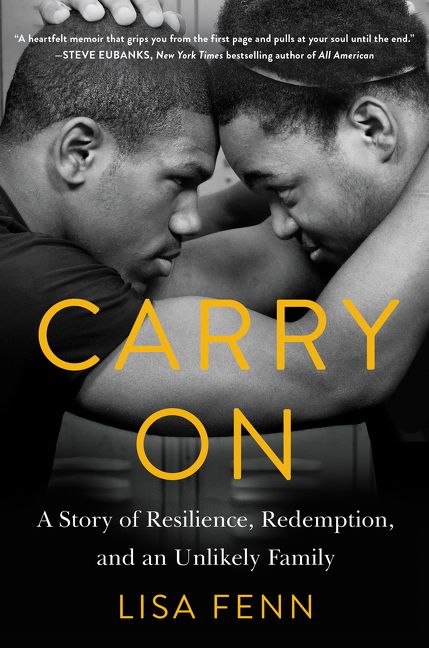
Carry On by Lisa Fenn

Carry On by Lisa Fenn
Published by Harper Wave ISBN 978-0062427830
Hardcover, $25.99, 256 pages

Every once in a while, I read a book that affects me so deeply, when I finish the book I feel the need to run and tell everyone I see "You must read this book!" Lisa Fenn's Carry On is one such book.

Fenn grew up in Cleveland, and became a producer for ESPN. On a visit home, her father showed her a newspaper story about two high school wrestlers from a high school in a poor section of the city. One of the young men was blind, the other had lost his legs in a tragic train accident.

She became intrigued, and convinced her boss at ESPN to film a short documentary piece on the young men by giving him a visual- "The one who cannot walk being carried by the one who cannot see." What came out of that piece changed Fenn's life forever.

Fenn got to know the young men- Dartanyon, a big guy who got shuffled from place to place, who always carried a duffel bag of his belongings with him because he didn't know where he would be sleeping that night, and Leroy, who lost his legs in a train accident when he was eleven and was living with his grandmother.

Both young men grew up in poverty in addition to their physical challenges. They became best friends. Dartanyon would literally carry Leroy on his back into wrestling matches, and he would frequently be found at Leroy's grandmother's home where he got a decent meal.

Their bond was unbreakable, and it took Fenn a long time to break through the defenses they had to get them to open up to her. They were suspicious of Fenn, of her motives for doing the documentary. She spent many hours watching them play video games in Leroy's grandmother's basement, eventually gaining their trust.

The resulting documentary was so moving that many viewers responded by asking how they could help these courageous young men. Fenn helped set up a fund for the young men to get them into colleges, a dream they couldn't even begin to comprehend.

She found people willing to help and through sheer force of will she got them to take the SATs and both of them were able to go to college. But Dartanyon and Leroy were completely unprepared for college life, and it became Fenn's full-time job to keep these guys on track.

Carry On is a book that looks at the bigger problem of  race, privilege, class and poverty through the prism of these two young men. For everyone who says, why can't people just pull themselves up by their bootstraps and succeed, the complications of that type of thinking is in here.

Fenn is a woman of faith, and I enjoyed that aspect of the book. She believed that she couldn't just walk away from these young men, that she could make a difference even when most people would give up.

Carry On will appeal to anyone who loves a good story about sports and the difference we can make in other people's lives. I cried throughout the book several times, and it reminded me of  Jeff Hobbs' brilliant book, The Life and Tragic Death of Robert Peace. Both books do a fantastic job of showing us a way of life most of us are unfamiliar with.

If you are the kind of person who only reads one book a year, make it Carry On. I would love to see this become a book read in high schools, colleges and in city reads program. It is the best non-fiction book I have read this year, hands-down.


Thanks to TLC Tours for putting me on Lisa Fenn's tour. The rest of Lisa's stops are here:

Tour Stops

Tuesday, August 16th: Emerald City Book Review
Thursday, August 18th: Becklist
Friday, August 19th: Dreaming Big
Monday, August 22nd: Mother’s Circle
Tuesday, August 23rd: bookchickdi
Wednesday, August 24th: Tina Says…
Thursday, August 25th: Literary Quicksand
Monday, August 29th: Helen’s Book Blog
Tuesday, August 30th: Cait’s Cozy Corner
Wednesday, August 31st: Book by Book
Thursday, September 1st: Many Hats
Wednesday, September 7th: Back Porchervations
Thursday, September 8th: Rebecca Radish
Monday, September 12th: Reading Reality
Tuesday, September 13th: The Paperback Pilgrim
Monday, September 19th: Reading is My Super Power

Wednesday, May 25, 2016

Erin McHugh at Barnes & Noble

Political Suicide By Erin McHugh
Published by Pegasus Books ISBN 9781605989785
Hardcover, $26.95, 256 pages


In a political season that no one could have seen coming, Erin McHugh has written the perfect book to accompany all the craziness- Political Suicide- Missteps, Peccadilloes, Bad Calls, Backroom Hijinx, Sordid Pasts, Rotten Breaks, And Just Plain Dumb Mistakes In The Annals Of American Politics.

McHugh spoke at Barnes & Noble 86th St. store in Manhattan a few weeks ago, the day after Ted Cruz dropped out the Presidential race, a week after he chose Carly Fiorina as his imaginary Vice-Presidential running mate. She introduced herself by saying "for those of you who don't know me, from Monday to Tuesday, I was briefly Ted Cruz's Secretary of State", which elicited huge laughs from the crowd.
Erin McHugh


Although we think this year's circus atmosphere is unusual, McHugh's book belies that fact. She read a few pieces from the book, starting with Robert Potter, a Congressman from North Carolina who castrated not one, but two men- a minister and a young boy, both of whom he believed were having an affair with his wife. In the South, castrating someone is called "potterizing".

She spoke of Marion Zioncheck, a Washington state Congressman who has the distinction of being the only sitting congressperson sent to an asylum. (I'm sure some citizens have other nominations for this category.)

Rita Crundwell committed the largest municipal fraud we never heard of, stealing over $53 million in her position as comptroller and treasurer of Dixon, Illinois, Ronald Reagan's hometown. It took her 30 years, and while she was stealing from the town to fund her horse farm and expensive clothes, furs and jewelry, the town literally fell apart. Roads didn't get paved, police cars went unrepaired. This one shocked me.

Familiar scandals like Senator Bob Packwood and Congressman Wilbur Mills sexual escapades were recounted, and although we have had some more recent scandals, like the Anthony Weiner sexting incident, McHugh's book features incidents that have already completed their story. We'll have to wait for the sequel to hear about those other ones.

In the lively Q&A section of the program, McHugh talked about the huge amount of research she did for this, starting with lists on Google and then researching many hours at the library. When asked what the standards of conduct are today versus history, McHugh replied that today's standards are low.

McHugh bemoaned the fact that people seem to have no manners anymore in the political arena. "They go one more step and one more step and next thing you know, you're talking about your member" in a national debate for President.

The media and the 24-hour news cycle contributes to this course discourse, and with the 2016 Presidential race gearing up, Erin McHugh's Political Suicide is the perfect book to pick up to remind yourself that our nation has survived political craziness before, hopefully we can yet again.

The short chapters make it an easy read, and political junkies will want to add this fun book to their collection. I highly recommend it.

McHugh also has two other timely books- Like My Father Always Said for Father's Day and Like My Teacher Always Said, which makes a great teacher's gift. You can find them here and here.


Wednesday, November 11, 2015

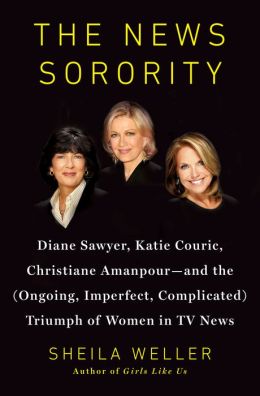
New In Paperback- The News Sorority by Sheila Weller

The News Sorority by Sheila Weller
Published by Penguin Books ISBN 9780143127772
Trade paperback, $18, 496 pages

In Sheila Weller's book, The News Sorority- Diane Sawyer, Katie Couric, Christiane Amanpour and the (Ongoing, Imperfect, Complicated) Triumph of Women in TV News, 
she takes us on a tour of the interesting lives of these three successful women. Diane Sawyer was the daughter of a successful judge and a "1950's version of a Tiger Mom" in Kentucky. She idealized her father and his death when she was a young woman devastated her.

Sawyer wanted a job in news, and with her steely reserve and driving ambition, she started at the bottom and worked harder than everyone else to work her way up the ladder from reporter to the press office for President Nixon to morning anchor at the CBS morning show to her latest home at ABC, where she became the face of ABC News, anchoring at various times Primetime, Good Morning America and finally ABC World News Tonight before recently retiring.

Katie Couric was raised in an upper middle class family in Virginia, and she was the youngest of three daughters, all of whom were intelligent and successful. Couric was a cheerleader in high school, and she used everything in her arsenal from her smiling, chipper personality to tenacity and strong work ethic to move from reporter at a Miami TV station to a mostly forgettable CNN reporter stint to Pentagon correspondent at NBC News to her breakout at The Today Show, and her short-lived stint as anchor of The CBS Evening News.

 Christiane Amanpour has been at CNN for many years. Her wealthy Iranian family fled their homeland when the Shah of Iran was overthrown and Amanpour was sent to a boarding school in England. Amanpour was star-struck and kept scrapbooks of Hollywood stars. She loved fashion and didn't seem to be the serious minded woman we know her as today.

The book takes us through the well-known aspects of these women's lives- Sawyer working with President Nixon on his memoirs after his resignation, her marriage to Mike Nichols, Couric's famous "ambush" interview with President George H.W. Bush and the terrible loss of her young husband and sister to cancer, Amanpour's war reporting and on-air confrontation of President Clinton over his policy in Bosnia.

Less is known about Amanpour, and perhaps that is why her story seemed more interesting. Her reporting from war zones, as in Bosnia, are harrowing and heart-pounding. Weller spoke with reporters, producers and tech people who accompanied Amanpour, and these sections of the book are the most compelling.

Amanpour's zeal to bring an important, horrific story about the genocide in Bosnia drives her to nearly single-handedly bring this story to the attention of the American people and politicians and demand action.

We get a lot of behind-the-scenes information, with the story of the early days of CNN being most intriguing (they had no bathroom in their building and had to use a nearby motel and gas station). The egos involved in the news business (Peter Jennings and Charles Gibson do not fare well here), the jockeying for position, and the politics of it all are enlightening.

The one thing that bothered me was the "unnamed sources" who were willing to say not-so-flattering things about the women without putting their name to it. The high school gossip-y feel of that detracted from the book for me. I found the things said by people willing to put their name to it more credible.

What shines through is that these successful women all had faced adversity and loss, and were driven to succeed in their field. They felt a calling to bring important information- Saywer's reports on childhood poverty, Couric's drive to inform people about colon cancer, and Amanpour's reports on war and religion- to the American people.

Fans of TV news will appreciate this book most, and I would love to read a book about the early pioneers of women in TV news, women most of us have never heard of who paved the way for today's well known successful women.

rating 4 of 5


Thursday, November 5, 2015

Stolen Years by Reuven Fenton

Stolen Years by Reuven Fenton
Published by Tantor Media ISBN 978-1-6301-5001-3
Trade paperback, $19.99, 224 pages


One of the few areas of agreement in a contentious Congress is the need to reform the criminal justice system. Lawmakers on both sides of the aisle agree that many people are incarcerated for far too long for minor offenses, such as marijuana possession, and that this is an issue that can be fixed.

This interest makes Reuven Fenton's book, Stolen Years- Stories of the Wrongly Imprisoned a topical book, and hopefully one that will be the beneficiary of this new scrutiny. Fenton, a reporter for The New York Post, has written about ten people who were falsely convicted and spent many years in prison before having their convictions overturned and winning their freedom.

While reading these stories, it is hard to fathom how so many people can fall through the cracks of the justice system. Whether through incompetence or malfeasance on the part of police and lawyers, innocent people's lives are destroyed and guilty people get away with crimes, allowing them to hurt other people.

Many of these stories have similarities; someone is brought in for questioning, and knowing that they are innocent, agree to speak with the police without a lawyer present. They are kept for hours in a room, barraged with questions, and told that if they just tell them the truth and confess, the police will work with them and they can go home.

Once they sign a confession, filled in with details by the police, the person is charged with the crime and their signed confession is used to convict them of a crime they did not commit.

They still can't believe that they could possibly be convicted of something they didn't do, and yet they find themselves in prison. Many of them spend their time working on their appeals, believing that they can find a way out.

One of the more interesting aspects of the book is the description of prison life. In the notorious Angola Prison in Louisiana, Damon Thibodeaux was shocked to discover that their are public tours of the prison, where people look at the inmates like they are animals in a zoo.

James Klupperberg was sentenced to Menard Correctional Center in southern Illinois, where he found that the inmates literally ran the prison, before the reforms of 1996 ended that practice. He described it as a "little city", where drugs were sold openly while people hung out on their corner, just like on the streets outside. (Think: TV's "The Wire")

The guys at the top of the chain of command had luxuries inside their cells- VCRs, portable washers, and stereos. Drugs were regularly smuggled into the prison, often by corrections officers. One enterprising person hit golf balls full of cocaine over the prison walls from the outside.

When they finally do get out of prison, the people who showed them kindness were often the correction officers. Many of them were happy to see these people get their justice and a chance to start a new life.

Another interesting theme of the book was what happened to these people when they were released after 15 years or more inside. The world had changed dramatically, and they faced many challenges, like finding employment. Even though their convictions were overturned, try explaining a 15-year employment gap on a job application.

The first meal outside of prison is very important, and we get descriptions of that. Many of them find it difficult to sleep in a soft bed when they get home.

Reading about a man falsely accused by his own daughter of rape, or a woman who lost her children when she was falsely imprisoned for killing her husband is heartbreaking. To be accused by someone you don't even know is bad enough, but to have family members turn against you is just unfathomable.

Anyone with interest in the justice system, and fans of the movie The Shawshank Redemption (which is everyone, right?) will want to read Stolen Years. It is enlightening and I recommend it.


Thanks to TLC Tours for putting me on Reuven Fenton's tour. The rest of his tour stops are here:

Reuven Fenton’s TLC Book Tours TOUR STOPS:

Monday, November 2nd: From the TBR Pile
Tuesday, November 3rd: Dwell in Possibility
Wednesday, November 4th: Dreaming Big
Thursday, November 5th: Bookchickdi
Monday, November 9th: Wildmoo Books
Tuesday, November 10th: Patricia’s Wisdom
Wednesday, November 11th: Julz Reads
Thursday, November 12th: Raven Haired Girl
Monday, November 16th: The Things We Read
Monday, November 16th: A Book A Week
Tuesday, November 17th: Diary of a Stay At Home Mom
Wednesday, November 18th: Good Girl Gone Redneck
Thursday, November 19th: WV Stitcher
Monday, November 23rd: Run Wright
Tuesday, November 24th: Broken Teepee – author guest post
Tuesday, November 24th: Life is Story


Wednesday, February 11, 2015

The News Sorority by Sheila Weller

The News Sorority by Sheila Weller
Published by Penguin Press ISBN 9781594204272
Hardcover, $29.95, 496 pages

If you have been following the news lately, you have no doubt heard about the suspension of NBC News' Brian Williams. If you are fascinated by this saga, you may wish to pick up a copy of Sheila Weller's book, The News Sorority- Diane Sawyer, Katie Couric, Christiane Amanpour and the (Ongoing, Imperfect, Complicated) Triumph of Women in TV News.

Weller takes us on a tour of the interesting lives of these three successful women. Diane Sawyer was the daughter of a successful judge and a "1950's version of a Tiger Mom" in Kentucky. She idealized her father and his death when she was a young woman devastated her.

Sawyer wanted a job in news, and with her steely reserve and driving ambition, she started at the bottom and worked harder than everyone else to work her way up the ladder from reporter to the press office for President Nixon to morning anchor at the CBS morning show to her latest home at ABC, where she became the face of ABC News, anchoring at various times Primetime, Good Morning America and finally ABC World News Tonight before recently retiring.

Katie Couric was raised in an upper middle class family in Virginia, and she was the youngest of three daughters, all of whom were intelligent and successful. Couric was a cheerleader in high school, and she used everything in her arsenal from her smiling, chipper personality to tenacity and strong work ethic to move up the ladder from reporter at a Miami TV station to a mostly forgettable CNN reporter stint to Pentagon correspondent at NBC News to her breakout at The Today Show, and her short-lived stint as anchor of The CBS Evening News.

Less is known about Christiane Amanpour, who has been at CNN for many years. Her wealthy Iranian family fled their homeland when the Shah of Iran was overthrown and Amanpour was sent to a boarding school in England. Amanpour was star-struck and kept scrapbooks of Hollywood stars. She loved fashion and didn't seem to be the serious minded woman we know her as today.

The book takes us through the well-known aspects of these women's lives- Sawyer working with President Nixon on his memoirs after his resignation, her marriage to Mike Nichols, Couric's famous "ambush" interview with President George H.W. Bush and the terrible loss of her young husband and sister to cancer, Amanpour's war reporting and on-air confrontation of President Clinton over his policy in Bosnia.

Less is known about Amanpour, and perhaps that is why her story seemed more interesting. Her reporting from war zones, as in Bosnia, are harrowing and heart-pounding. Weller spoke with reporters and producers and tech people who accompanied Amanpour and these sections of the book are the most compelling.

Amanpour's zeal to bring an important, horrific story about the genocide in Bosnia drives her to nearly single-handedly bring this story to the attention of the American people and politicians and demand action.

We get a lot of behind-the-scenes information, with the story of the early days of CNN being most intriguing (they had no bathroom in their building and had to use a nearby motel and gas station). The egos involved in the news business (Peter Jennings and Charles Gibson do not fare well here), the jockeying for position, and the politics of it all are enlightening.

The one thing that bothered me was the "unnamed sources" who were willing to say not-so-flattering things about the women without putting their name to it. The highschool gossip-y feel of that detracted from the book for me. I found the things said by people willing to put their name to it more credible.

What shines through is that these successful women all had faced adversity and loss, and were driven to succeed in their field. They felt a calling to bring important information- Saywer's reports on childhood poverty, Couric's drive to inform people about colon cancer, and Amanpour's reports on war and religion- to the American people.

Fans of TV news will appreciate this book most, and I would love to read a book about the early pioneers of women in TV news, women most of us have never heard of who paved the way for today's well known successful women.

rating 4 of 5

Monday, February 9, 2015

The Short and Tragic Life of Robert Peace by Jeff Hobbs

The Short and Tragic Life of Robert Peace by Jeff Hobbs
Published by Scribner ISBN 978-1-4767-3190-2
Hardcover, $27, 402 pages
Sometimes you read a book that, when you finish, you want to put in the hands of everyone you meet. I feel that way about Jeff Hobbs' The Short and Tragic Life of Robert Peace.

Peace is the son of Jackie, hard-working single mom from Newark, New Jersey. His father Skeet is a drug dealer who is in his life, until he is convicted of murder and sent to prison. Jackie wants her son to have a better life, and she encourages him to read and get an education. Skeet wants him to be street-smart.

Jackie works hard at a minimum wage job to get Rob into St. Benedict's, a private Catholic prep school. Rob is smart, and Jackie hopes that he can use this as a stepping stone to a better life.

Not only is Rob smart, he is a hard worker. He works as a lifeguard at the school pool, and is a star on the water polo team. He has a core group of three other neighborhood guys he hangs out with, and if he can stay away from the dangers of the streets, he could actually go places.

When a wealthy alumnus from St. Benedict's offers to pay Rob's tuition at Yale, it seems that Jackie's wishes for her son may come true. Rob goes to Yale, but life there is very difficult. He needs money, and his janitor's job doesn't pay enough.

So Rob turns to easy money- selling drugs on campus. He makes a good living at this, and has enough saved up to take care of his mom. All along, Rob has been working on a judicial appeal for his father, spending free time in legal libraries trying to find a way our for his dad.

Rob's college roommate Jeff Hobbs was fascinated by the life Rob led, a life so different from everyone else's at Yale. They became good friends, but lost touch after graduation.When Rob's life was tragically cut short, Hobbs set out to find out what happened to his friend, and so he interviewed Rob's family and friends to create this stunning book.

Although you know by the title that it has a sad ending, you can't help but root Rob on in the book. How does someone with so much promise and energy end up drifting from dead-end job to dead-end job? Hobbs does his best to show how a life lived in grinding poverty in a country where upward mobility is prized and available slipped through Rob's grasp, through choices he made and circumstances he couldn't control.

The Short and Tragic Life of Robert Peace is about race, poverty, family, drugs, life on the street, education, and so much more. It's the kind of book that you must stop while reading to think about what is happening and question how we as a country can help people who work hard and want a way up succeed.

It brings out an empathy in the reader for people who face these challenges, but it would nice if it can bring about change too. It's the kind of book I wanted to speed though on one hand, and on the other, I didn't want it to come to its inevitable conclusion. It is brilliant and heartbreaking and honest. It is simply one of the most important books I have ever read.

My husband and I just finished binge-watching The Wire, and anyone who appreciated that show should read The Short Life and Tragic Death of Robert Peace. They share similar sensibilities and shine a light on the same issues.

rating 5 of 5

Monday, November 17, 2014

Beach Club Book Club- GI Brides by Duncan Barrett & Nuala Calvi

GI Brides  by Duncan Barrett and Nuala Calvi
Published by William Morrow ISBN 978-0-06-232805-2
Trade paperback, $14.99, 361pages

After talking to her grandmother Margaret about her experiences as a GI bride, author Nuala Calvi knew that there was a book in that. Along with Duncan Barrett, they did much research and from that came the book GI Brides: The Wartime Girls Who Crossed the Atlantic for Love. 

The focus of the book is on four British women- Margaret, Lyn, Rae and Sylvia. The story begins in the days of WWII in England, where these young women worked and volunteered in the war effort. They each met an American GI, fell in love, and married their soldier.

When the war was over, the men went home, and their new brides soon followed. Our Beach Club Book Club received copies of the book from The Book Club Girls, and we discussed it yesterday over breakfast at Le Pain Quotidien before doing a little Christmas shopping at the Winter Village at Bryant Park in midtown Manhattan.
At Bryant Park

One of the topics of discussion included the incredible number of British women who married U.S. soldiers. At the end of the war, over 70,000 women had to be transported to America to begin their new lives. We all marveled at the sheer logistics of doing this, and how the U.S. government, along with aid from the Red Cross, was able to get these women on ships and to their new husbands.

As expected, the adjustment to their new lives was difficult. Along with cultural differences, many of these women didn't know exactly what they were getting into. They only knew their husbands briefly before marrying them, and we wondered if they married so quickly because of the shortage of young men in England (so many were killed during the war), or because they realized that life was short and you couldn't let it pass you by.

We admired the bravery of these women, leaving their families and homes and traveling thousands of miles away. When things got difficult- one husband was an alcoholic, one was a gambler, one was a philanderer, one had mother issues- these women didn't have much of a support system to rely on to help them. And going home was not an option.

Rae's bravery impressed us. She left her cheating husband and found a job as a live-in nanny with a wonderful family. She loved the family, and they loved her, but she knew eventually she would have a build a life of her own, which she did.

Sylvia ended up in Baltimore, living with her husband Bob and his family. Bob had a gambling problem, and his family enabled him, even encouraged his behavior. Sylvia later found support by joining groups founded by other GI war brides.

Lyn ended up with her husband Ben in California. Ben's Italian family were very close, and his mother was a stereotypical Italian mother. She washed and ironed her son's clothes perfectly, and cooked elaborate Italian meals. Lyn could not meet her mother-in-law's impossible standards, and was very unkind to her non-Italian daughter-in-law, and that caused much conflict.

Margaret and the charismatic Lawrence had three daughters, and Lawrence's alcoholism deteriorated into domestic violence. Having nowhere to turn, Margaret moved to Ireland, where her abusive mother took in her and the children.

All of these women showed an amazing ability to overcome tough times and difficult marriages. They made the best lives they could, and eventually thrived and even found happiness.

We all agreed it took awhile to get into the book, and it was difficult to keep the women and their husbands straight at first. But as we read, it became easier and we found each women's story so interesting. We thought that either a chart in the beginning with each woman and her husband and children and family would have helped, or perhaps telling each women's story in their own section as opposed to in chronological order may have solved that issue.

rating 4 of 5